I think that what he said was true. To really appreciate nature you have to get in a place where you are away from society, a place where u can be alone to have the time to think. One part that I liked was the part where he said that few people can see nature and appreciate. I liked it because it was a true statement. It kind of reminds me of the other day when my mom asked me “Did you thank a tree today?” I said no, but what she was getting at was the fact that without things in nature we wouldn’t be living. We take many things in nature for granted. But the part where he talks about being a part of god was somewhat crazy in my book. In self reliance, Emerson basically says that you achieve greatness through accepting your fate. I think that many things contribute to greatness. Things like I mentioned in my 12 virtues. I really liked Thoreau’s philosophy on the government. He said that “government is best when it governs not at all”. As a liberal I agree, but I also think that government should help people when they are in need.
“Nature” is a good example of transcendentalism because it talks about coming closer to god by getting closer and appreciating nature. He states: “I become a transparent eyeball; I am nothing; I see all; the currents of the universal being circulate through me; I am part or parcel of god.” This is a direct example of what the transcendentalism because they believed god talks to people through their brain.
“Self reliance” is a good example of transcendentalism cause it talks about the importance of being an individual. He says to “accept the place the divine providence has found for you”, which basically means that god made you how you are and that you should accept it.
“Civil Disobedience” is a good example of transcendentalism because Thoreau begins by saying “that government is best when it governs least”. This is a good example because transcendentalists believed that people should listen to their instinct instead of following society.
I chose scenario #1. What I would do in this situation would be to go ahead and go to college and then after graduation I’d get married. If this happened to a transcendentalist they would follow their instinct. In self reliance Emerson says “Trust thyself: every heart vibrates to that iron spring” Which is basically saying that you should trust every decision that you make, because in listening to intuition you are listening to the voice of god.
The transcendentalists believed that to be able to connect with god you had to get away from society and among nature so that you could be yourself the way god made you.(“To go into solitude, a man needs to retire as much from his chamber as from society.”) I picked this quote Because, in listening to your intuition you are listening to the voice of god. The man in the video is “alone in the wilderness” I have no idea if he’s a transcendentalist or what though. The man in the video also doesn’t stay in his little cabin the whole time. He spends a lot of time outside in the “wilderness” alone.
Thursday, March 27, 2008
Transcendentalism
Thursday, March 20, 2008
Writing 3
History of Tattooing
The history of tattoos dates back to 12,000 years BC. Tattooing is one of the oldest forms of art, and it is believed that the first tattoos were created by accident. The art form had been claimed over the years by many countries’ tribal groups and ethnic groups. Tattoos have always played an important role in ritual and tradition. We will prolly never know what group of people were the first to mark their skin. Tattooing did not begin in one specific place on earth and spread like most phenomenons. All places and all societies have practiced the tattooing in some way.
. The word “tattoo” is very modern. Many people believe that it derived from the Polynesian root word “tatao” which translates to “to tap” but researchers suggest that it derives from the Tahitian word “tatu” which means “to mark”.
In recorded history the earliest tattoos can be found in Egypt during the time of the pyramids. When the Egyptians expanded their empire the art form spread to other civilizations like Crete, Greece, Persia, and Arabia and then spread from there. The Chinese adopted the form around 2,000 B.C.
In ancient time tattoos were used for many reasons. The Greeks used tattoos for communication among spies. Romans used it to mark criminals and slaves. In western Asia the Ainu people used it to show social status. Females were marked to show their place in society. People were also marked to show what tribe they belonged to. In the western hemisphere the early Brits used tattoos in ceremonies. The Danes, Norse and Saxons tattooed their family crests.
In 787 A.D., The pope banned tattooing, but it still thrived in Britain until the Normans invaded the country in 1066. Thus, Tattooing disappeared from western culture from the 1100s to the 1500s. In 1691, William Dampher, a sailor and explorer who traveled the South Seas, re-introduced tattooing to the west. Upon returning to London from an exploration he brought a heavily tattooed Polynesian named Prince Giolo who was put on exhibition as a money making attraction and became a sensation. In the late 1700s another explorer named Captain Cook brought a heavily tattooed Polynesian man named Omai to London and he became the trendsetter of the tattooing fad. Soon many people of the upper class were getting small tattoos on discreet places on their bodies.
In 1861, Samuel O’Reilly, an American tattoo artist, invented the first electronic tattooing machine. He opened up a shop in Chatham square in New York City. During this time tattooing was decreasing in popularity in other parts of the country, but in this small section of New York it was all the rage. It was also during this time that cosmetic tattooing became popular. When the depression hit in the 1920s, Chatham Square lost it’s appeal and the center of art moved to Coney Island. Although many shops had sterilization equipment few used them. Newspapers started reporting storied of blood poisoning, Hepatitis, and other diseases. Thus the government stepped in and put a health code violation into effect and many Tattoo shops were shut down, and Tattooing became illegal. In the late 1960s peoples take on Tattoos changed. And today tattooing is more popular than it has ever been. Because of the rise in popularity, Tattoo art has been placed in the category of fine art.
Tattoos are a very important form of art. If you look at a person with tattoos on their body it can tell you all about that person. For example, many people get tattoos with the names of their children, or someone who died who was very close to them. Over the years, the process of tattooing has changed but the art form still remains the same.
Monday, March 17, 2008
American Romanticism
1. Response to Rip Van Winkle-
Rip van winkle was a very peculiar story. I didn’t think I’d like reading it at first because it was sort of hard to follow with so many strange words that I didn’t know the meaning of. I was familiar with the story but I had never actually read it before, after reading it I came to the conclusion that Rip is a very common type of character. The character of Rip Van Winkle reminds me of a Peter Griffin or Homer Simpson, because he’s kind of a loser. He’s always being annoyed by his wife and stuff so he trys to avoid her, which is pretty hilarious. He pretty much hates his home life but he seems to try and make the best out of it.
I really liked the story. One of my favorite parts was the part where he’s in the woods squirrel hunting with his dog wolf and the little man with the keg calls his name and asks for his help. Even though the story was a big strange it was still entertaining.
2. Two reasons why this story can be called romantic is because it uses an ordinary character(“In that same village, and in one of these very houses (which, to tell the precise truth, was sadly time-worn and weather-beaten), there lived many years since, while the country was yet a province of Great Britain, a simple good-natured fellow, of the name of Rip Van Winkle. He was a descendant of the Van Winkles who figured so gallantly in the chivalrous days of Peter Stuyvesant, and accompanied him to the siege of Fort Christina. He inherited, however, but little of the martial character of his ancestors. I have observed that he was a simple good-natured man; he was, moreover, a kind neighbor, and an obedient hen-pecked husband. Indeed, to the latter circumstance might be owing that meekness of spirit which gained him such universal popularity; for those men are most apt to be obsequious and conciliating abroad, who are under the discipline of shrews at home. Their tempers, doubtless, are rendered pliant and malleable in the fiery furnace of domestic tribulation; and a curtain lecture is worth all the sermons in the world for teaching the virtues of patience and long-suffering. A termagant wife may, therefore, in some respects, be considered a tolerable blessing; and if so, Rip Van Winkle was thrice blessed.”) and imagination. When I think of the use of imagination in this story I think of the part where he falls asleep after meeting the little man (“As he was about to descend, he heard a voice from a distance, hallooing, "Rip Van Winkle! Rip Van Winkle!" He looked round, but could see nothing but a crow winging its solitary flight across the mountain. He thought his fancy must have deceived him, and turned again to descend, when he heard the same cry ring through the still evening air; "Rip Van Winkle! Rip Van Winkle!"”).
3. Thanopsis summary-
This poem basically says that death is not necessarily a bad thing. When we die( we meaning everyone) we all become the earth. Some people have concerns about nobody being able to remember them when they die. But that it doesn’t matter because people are still going to do whatever the same things they’ve done. So you should live everyday until you die, and when your time comes embrace it. This poem is romantic because it focuses on Nature and basically said that everyone is going to become the same thing in the end no matter who you are.
4. The ropewalk –
So this poem is about a guy who works in a rope factory, who is really bored and starts imagining what the rope he’s making might be used for. Images of chicks swinging on a swing, a girl walking on a tight rope, and the gallows pop into my mind. This poem is a good example of Romanticism because it had imagination in it. This is a main characteristic of Romanticism.
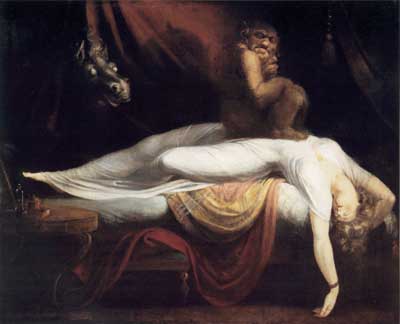
5. To me this piece of art could be considered romanticism because it depicts a beautiful landscape. After researching Romanticism in art I found out that it is generally characterized by a highly imaginative and subjective approach, emotional intensity, and a dream-like or visionary quality. I chose a painting called “the nightmare” by Henry Fuseli. Which depicts a woman sleeping having a nightmare. I picked this because of it’s imaginative approach with emotional intensity.
Monday, March 3, 2008
Independant reading
So far the book is about a Private investigator named jackie morrissey who get hired by a vampire named Bestien to find his cousin Vincent's sabatour. In the beginning There was a conflict between Jackie and Vincent because jackie seems to be prejudiced against vampires because she had be abused by one in the past, and Vincent seemed to dislike her because she weas a girl and a mortal.
Thursday, February 21, 2008
The Rationalists
Puritans vs. Rationalists-
There are several differences between the puritans and the rationalists. One major difference was the religious beliefs. The Rationalist believed in a more do-gooder type god rather than this evil god that the puritans believed in. The Rationalists also were more educated, cause they liked proving things with science. Rationalists also believed that society should be run using natural law whereas the puritans believed that god decides who got these rights.
Ben Franklin is a rationalist-
Ben Franklin is a good example of a rationalist because he used the power of thought to reach moral perfection, whereas a puritan would’ve asked god instead of creating a scientific way to improve themselves morally.
My 13 virtues-
1. honesty- being able to tell the truth
2. patience- being able to wait for things
3. kindness- being nice and respecting yourself and others
4. trustworthiness- being able to be trusted and depended on
5. open-mindedness – being willing to receive new ideas
6. humbleness – modesty do not boast or brag
7. caution – paying attention to safety when needed
8. obedience- being able to obey and carry out orders when necessary
9. gratitude – being thankful for what you have
10. Generosity – giving or willingness to give freely
11. faith – having faith in yourself, others, and what you believe in
12. Justice- always do the right thing no matter what
13. determination-never giving up
Rationalist thoughts-
Rationalists thought that all men are created equal, unlike the puritans who believed in the chosen few. They also believed that everyone was born with certain rights given to them by god. They thought that if a government is messed up that the people had the power to change it. “it is the right of the people to alter or abolish it, and to institute a new government”
Tuesday, February 19, 2008
Writing two
Vlad III Dracul Vlad Tepes was born in the citadel of Schässburg (Sighişoara) in Transylvania in 1431. He was the second son of Vlad II Dracul (whom he was named after) and Princess Cneajna of Moldavia. Young Vlad was raised in Wallachia, well educated and when he was of age he trained to become a knight. Pretty soon his world would turn upside down as his father was forced to make a huge decision. His father belonged to the order of the dragon which was an order of selected nobles modeled on the Order of Saint George of Hungary that was created to defeat the Turks, whom at the time was trying to take over Europe. After the Turks took over Constantinople they became a serious threat to Vlad II Dracul’s kingdom. So he decided to send his sons to live in exile. But Young Vlad and his brother Radu became prisoners for four years. While being held captive Vlad had grown very resentful, and vowed to have his revenge.
In 1447 Vlad II Dracul was assassinated by a group lead by John Hunyadi, one of his relatives. It was then that Vlad III was granted freedom. He also learned of his brother Mircea’s horrifying death. Mircea had his eyes gouged out and buried alive by his political enemies the boyars of Tirgoviste. Vlad fled to Moldavia until October 1451, and was put under the protection of his uncle Bogdan II. Bogdan was assassinated at a wedding, and Vlad III fled to Hungary.
During this time the Throne of Wallachia was occupied by the Boyars. At age 17 Vlad III and Pasha Mustafa Hassan's Turkish cavalry defeated the boyars, thus Vlad reclaimed the throne for a short time. Soon after the defeat of the boyars, Hunyadi appointed Vladislav II to the post. It was then that Vlad formed an alliance with Hunyadi with hopes that he could convince him that he was the rightful heir to the throne. In July of 1456 he made his move, killing his father’s murderer and defeating Vladislav II, taking over as the ruler of Wallachia.
His First act of revenge was aimed at the boyars of Tirgoviste for killing his father and brother. On Easter Sunday of 1459 he held an Easter feast and arrested all the boyar families who attended. He impaled the older ones on steaks and forced the others to march fifty miles to the town of Poenari. After that he ordered the remaining survivors to build him a fortress on some ruins overlooking the Arges River, many people died in this process and what is left of the building today is known as Dracula’s Castle.
During his Reign Vlad Dracula had skinned, boiled, decapitated, blinded, strangled, hanged, burned, roasted, hacked, nailed, buried alive, stabbed, etc., all for his own amusement. But his Favorite Impalement was impalement on steaks, hence his last name “Tepes”. “Tepes” means "The Impaler" in Romanian. There were many stories of Vlad Tepes Philosophies. For example: He was known for his defense on Honesty and Order. Almost any crime could be punished by impalement.
In 1462 Dracula attacked the Turks to drive them out of the Danube river valley. In retrospect, The Sultan Mehmed II, Sultan of the Ottoman Turkish Empire, invaded Wallachia with an army three times larger than Vlad’s. Vlad retreated to the capital, Tirgoviste. He left the Turkish army with no food or water by poisoning wells and burning down his own villages. When the sultan and what was left of his army reached Tirgoviste they saw 20,000 Turkish prisoners all impaled. Reluctantly, the sultan retreated, but Dracula’s younger brother Radu stayed. The Turks gave Radu an army in hopes that they could seize the throne. Radu’s army followed Dracula to Poenari.
According to Legend, An archer shot an arrow with a message through a window in to Dracula’s living quarters, and upon reading the message Dracula’s wife threw herself off the tower into the water flowing beneath the castle. The Turks seized the castle, but Dracula escaped through a secret tunnel. After Dracula fled from Wallachia he went to Matthias Corvinus for help. Instead of helping Dracula, the king imprisoned him in a tower. Later, with help from the Corvinus, he became prince of Wallachia and was assassinated less than a year later. After 6 short years his reign had finally ended.
Monday, February 4, 2008
Independant Reading week 4
My independant reading book is kiss of crimson. It's about a vampire named Dante who works for a group that fights against "Rogue" vampires. Vampries that are "rogue" are sanguinary creatures that prey upon humans uncontrollably, and once a vampire turns "rogue" he can't turn back. So far we've found out that some of the vampires that have turned rogue have been using a drug called Crimson.